Francis GRUBER 1912-1948
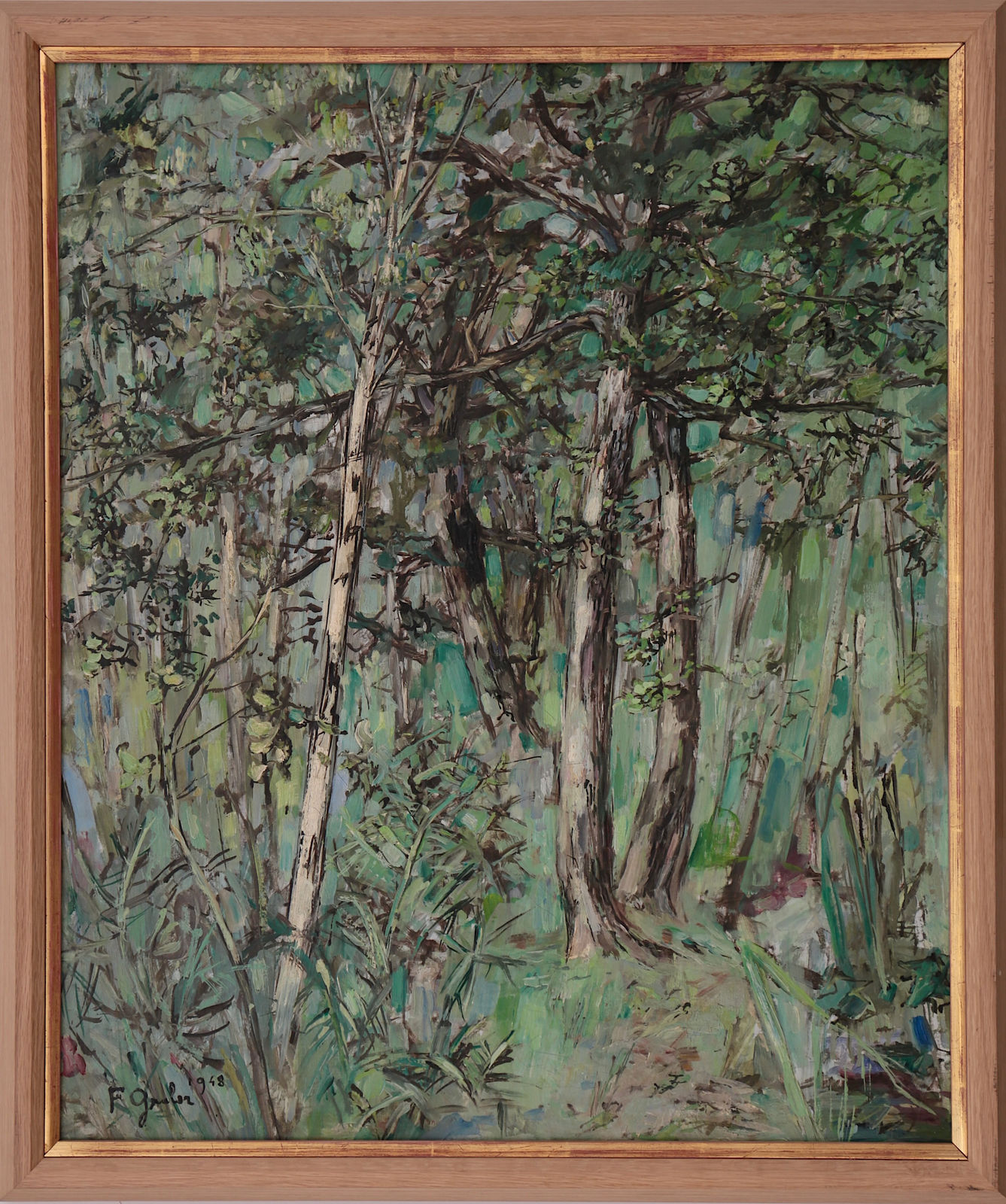
The work depicts a dense undergrowth where the trees, foliage, and vegetation occupy almost the entire surface of the canvas. Deep greens dominate the composition, punctuated by subtle variations. Vertical trunks structure the space while light struggles to filter through the leaves, creating a silent and mysterious atmosphere.
Francis Gruber does not seek to represent an idyllic landscape. On the contrary, the forest appears thick, almost oppressive. The colors and the pictorial material convey an inner emotion rather than a mere observation of nature.
This work was painted in 1948, the year of the artist’s death. Suffering from tuberculosis, Gruber found in the landscapes of Thomery and the forest of Fontainebleau a refuge away from the bustle of Paris. The undergrowth thus becomes a space of calm, but also of meditation on the fragility of life.
The composition is built around the vertical lines of the trees, which provide stability, while the dense vegetation reinforces the impression of enclosure. The light, discreet, nevertheless brings a note of hope by illuminating certain parts of the foliage.
Sous‑bois (Undergrowth) can be interpreted as a symbolic work: nature is not merely a backdrop, it reflects the painter’s feelings. The contrast between shadow and light evokes the struggle between anxiety and hope.
This landscape invites contemplation and expresses the melancholic sensitivity characteristic of Francis Gruber.
With Sous‑bois (Undergrowth), Francis Gruber shows us that a simple landscape can express profound emotions. Through its realism, its intense colors, and its hushed atmosphere, this work testifies to the expressive power of French figurative painting of the postwar period and to the artist’s personality.

Subscribe to our Newsletter
YES, I would like the Galerie de la Presidence to send me invitations and information about its exhibitions and artists.
denotes required fields
En soumettant ce formulaire, vous acceptez de recevoir notre newsletter.